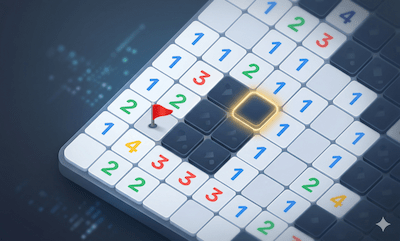
Minesweeper has been a staple of personal computers since its inclusion in Windows 3.1 in 1992. What began as a simple time-killer has evolved into a game of pure logical deduction. This week, we dive deep into the systematic approaches that transform beginners into Minesweeper masters.
1. The Fundamental Rules
Before mastering Minesweeper, you must internalize its core mechanics:
- Objective: Reveal all non-mine cells without triggering a mine
- Numbers: Indicate how many mines surround that cell (orthogonally and diagonally)
- Flags: Mark suspected mines to avoid accidental clicks
- Win Condition: Reveal all safe cells
The elegance of Minesweeper lies in its simplicity—yet this simplicity hides profound logical complexity.
2. The First Click: Always Safe
Modern Minesweeper implementations ensure your first click is always safe. However, the placement of your first click matters:
- Corner: Limits potential information but offers clear edges
- Edge: Provides moderate information with manageable boundaries
- Center: Maximizes information but creates complex interconnections
For beginners, starting near an edge provides a gentler introduction to pattern recognition.
3. Essential Patterns Every Player Must Know
Pattern 1-2-1
When you see the sequence 1-2-1 along a line, the mine is always in the center cell adjacent to both 1s. This pattern eliminates multiple unknowns at once.
Pattern 1-1
Two adjacent 1s sharing a common neighbor means that neighbor cannot be a mine. The mine must be elsewhere.
Pattern 3-3-3 (Advanced)
In complex configurations, three consecutive 3s create powerful elimination opportunities.
The Corner Solution
When a 1 touches a corner, and the diagonal cell is the only unknown, it must be the mine.
4. The 50-50 Myth
Many players believe Minesweeper becomes pure guesswork at the end. While some uncertainty exists, true experts minimize luck through:
- Global Analysis: Understanding the entire board state, not just local cells
- Probability Calculation: When guessing is necessary, calculate which option has higher probability
- Information Preservation: Every click should maximize future information
The "50-50" guess appears when players haven't gathered enough information earlier. Expert play reduces guessing to near-zero.
5. Flagging Strategy
Flagging is controversial among Minesweeper players:
- Pro-Flag: Prevents accidental clicks and aids visualization
- Anti-Flag: Flags consume time and can be incorrect
The middle ground: Flag only when genuinely uncertain. For intermediate cells where you're confident, clicking unflagged is faster and equally safe.
6. Speed Techniques for Experts
Chord Click
Click both left and right mouse buttons simultaneously on a revealed number. This auto-reveals all adjacent non-flagged cells if the flag count matches—saving precious milliseconds.
Pattern Chaining
Chaining multiple patterns together creates "ripple effects" where solving one pattern reveals information that solves another automatically.
Board Scanning
Don't just react to revealed numbers. Proactively scan for patterns across the entire visible board.
7. Difficulty Levels: Setting Your Challenge
Minesweeper difficulty is defined by grid size and mine density:
- Beginner: 9×9 grid, 10 mines
- Intermediate: 16×16 grid, 40 mines
- Expert: 30×16 grid, 99 mines
Master each level before advancing. Expert-level Minesweeper requires not just logical skill but emotional composure.
8. The Psychological Element
Minesweeper is as much a mental game as a logical one:
- Patience: Rushing leads to mistakes
- Confidence: Doubt causes hesitation and inefficiency
- Acceptance: Some losses are unavoidable; learn and move on
Professional Minesweeper players train their minds to maintain perfect focus for extended periods.
9. This Week's Challenge
This week's focus is consistency. Set a personal goal:
- Complete 5 Intermediate games without any 50-50 guesses
- Identify and name 5 distinct patterns in your games
- Reduce your average Expert completion time by 10 seconds
10. Conclusion
Minesweeper rewards systematic thinking. Unlike games of chance, every loss reveals a logical gap in your analysis. Embrace the puzzle, respect the numbers, and watch your win rate climb.
Ready to test your logic? Play Minesweeper Now